How to Stop a Runaway Train (or: how not to be an anxious wreck)

Essay, Personal

Maybe your heart races all the time and you’re not sure why. It batters your ribcage like a dazed bird against a windowpane. You skip breakfast because you have a vague, persistent ache in your stomach. If you speak in class you start stuttering like your pulse.
Maybe you’ve got memories that reel unbidden through your mind,  a movie on mute and fast-forward. You sleep little. Sometimes you shake. City buses make you implode. Your internal monologue is very scared and very loud, much of the time.
“Anxiety is the dizziness of freedom.” I saw that scrawled on a bathroom stall. I like the the ring of the words, though I don’t know if they’re true. I do know a few ways to quell dizziness.

1. Go for ambling, aimless walks: you need to get out of your head. It doesn’t much matter where– urban and natural landscapes alike are throbbing with Things That Have Nothing to Do With You. It’s grounding to be amongst them. Try to think of nothing but the flex of your muscles and the rhythm of your steps. Take hard, hungry breaths that burn your lungs a little.

2. Make a Playlist for Chilling Out. This doesn’t have to be a slow or soft playlist. Ambient electronica might be soothing for a lot of people, but maybe the rawness of riot grrl or hiphop does it for you. Have no regard for niche or snobbery– if Ke$ha calms you down, have no shame.

3. Clean like a motherfucker.

4. Make art, whether you think you can or not. Perfectionism is paralysis, and breeds more anxiety. Urgent creativity is cathartic and sometimes produces shitty art. That’s great– shit is fertilizer.

5. If these methods sound a little clichéd or superficial, it’s because they are– they’re worth doing, but they won’t provide sustainable stability. Mental illness is cyclical. Severe anxiety can’t be washed away in a bubble bath. Find a good shrink if you haven’t. If you’re uninsured, don’t be afraid to ask about a sliding scale; many therapists will be willing to work with you or to refer you to someone who can. If you’re a student, your campus may have free counselors. Keep in mind, though, that therapy can make you feel messier sometimes. Analysis doesn’t necessarily help the hyper-analytical. Medication is fickle and can be hard to obtain. If treatment isn’t feasible for you, coping mechanisms become vital. Know yourself and what you need. Try not to get entangled in self-diagnosis- the internet can make you into a psychological hypochondriac. You are not a list of symptoms.

Some resources/reading:
National Suicide Prevention Lifeline
The Icarus Project
Mad in America
The Magic Bullet by Anita Felicelli for The Rumpus
 On Falling Apart by Sady Doyle for Rookie
 Blue Christmas by Rachel Prokop for Rookie
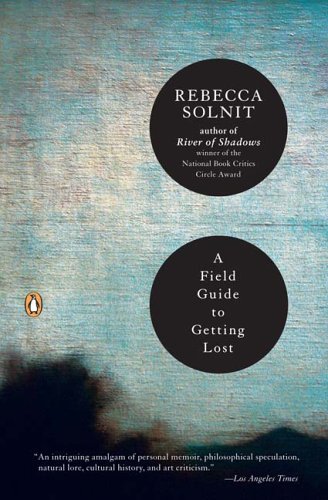
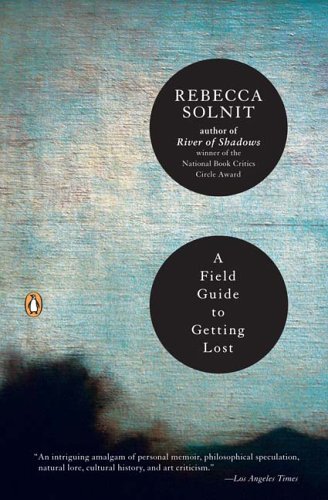
Book Review: A Field Guide to Getting Lost by Rebecca Solnit

Book Review

Though the title of this book is paradoxical, it becomes oddly accurate, as Solnit guides the reader into an introspection and a comfort with not knowing, with being lost. It is one of those text-artifacts that is what it means, in that Solnit not only writes about various ways of getting lost, but has a language that spirals in on itself, refusing clarity in search of a deeper grace. From meditations on blueness, to story-songs that map landscapes, to white settlers (or invaders) taken captive by Native Americans in the 1800s, and through her own flirtation with punk rock, Solnit leads the reader on a fascinating, meandering tour.

Readers could expect this book to be absorbed in geography and landscape, but what is surprising and lovely is the intensity with which Solnit stares beyond these landscapes, into their hidden things. There is much meditation on this book about darkness, about mystery. And though there are many quotes I could choose, I think this one suits my purposes:

“It is the job of artists to open doors and invite in prophesies, the unknown, the unfamiliar; it’s where their work comes from, although its arrival signals the beginning of the long disciplined process of making it their own. Scientists too, as J. Robert Oppenheimer once remarked, ‘live always at the ‘edge of mystery’­—the boundary of the unknown.’ But they transform the unknown into the known, haul it in like fishermen; artists get you out into that dark sea.”

The dark sea is of course blue, a color that Solnit constantly re-evokes because of its connection with distance, with lost things: blue—as in the sky, as in the ocean, as in the faraway—is not real, but an intricate mixture of light and desire.

I wondered, after reading this book, about my ability to access the dark blue unknown, to go there and get lost. With my GPS and my cell phone, with email and social media accounts and blogs, with Google tracking all of my website visits and advertisers targeting their online commercials to my preferences, there is no longer the same possibility for being lost: for remaking and renaming oneself; for transformation. It feels crass to bring the buzz of the digital age into conversation with Solnit’s work, which is so deeply engaged with the real and the true of history or nature and never with the cheap, passing fads of popular culture. Still, our post-Enlightenment culture worships science, and with these technologies we all seem to be desperately striving to make the unknown known, to haul in all of the mystery and desire we can find, map it, tag it, and monetize it.

I left Facebook for a matter of months and some of my friends behaved as though I had left the world, had gone missing. In the summer during this hiatus a more iconoclastic, nomadic friend passed through town and we met at an arranged time and place because he had discarded his cell phone somewhere between North Carolina and Utah. We found each other but got lost in the park where we walked, forgetting the time along the way. We discussed trust and how leaving digital life is a form of going astray; there comes a doubt, a frustration, from others who would prefer you to be always found. I would like to say that losing a cell phone or an online account is like getting lost in Solnit’s sense, but it is only a taste of that underworld; further transformation cannot take place with so many watching. Much of A Field Guide tells stories of hermitage, of reveling in solitude.

Solnit recognized the anxiety we have historically felt about getting lost, about separation from community, about the unknown. But seven years after she published this book, I have to think that anxiety has been amplified with our fixation on digital identities. Recently I recreated my Facebook profile and was instructed many times, in the imperative, to “find friends”. Today Google+ informed me, after I added three Broad! editors to my circle for a virtual meeting, that I “might be lonely!” if I didn’t contact more people. I think if we are anxious about getting lost, with its implications of loneliness and separation, we are now even more fearful of being lost, of not being remembered in an age when every moment can be simultaneously archived forever and forgotten immediately, buried under so much that is happening in the present. But to continue with Solnit’s paradox, I hope A Field Guide to Getting Lost never will be lost or forgotten; it is an increasingly relevant work of literature that promises to endure.

GO VOTE TODAY.

Uncategorized

This is the second presidential election I have been legal to vote in. The first, in 2008, was my study abroad semester in college and I voted absentee a few weeks before Election Day. (I’ve been lucky to have some amazing experiences in my life.)

So, okay. It’s the day before the 2008 election, and my American flatmate and I are on an elderly bus jolting up a mountain in Sicily. There’s a medieval-era, gated village at the summit and we’re damn well going to see it before we fly to Barcelona the next day. We’ve been trying to catch this bus for three days.

We find ourselves outside the gate with two others, a man and woman about our age. “Canadian?” the man asks, with a strong Australian accent. We explain we are American, actually.

“Interesting time to be an American.”

“Yeah! Tomorrow!” And the four of us laugh awkwardly, thinking of what the next night might bring.

It turned out that the Australians knew a ton about our election. As in, they had been following it religiously online, on television, even on the radio. They knew who Sarah Palin and Tina Fey were. They quoted interviews with Biden that I hadn’t heard of, and I thought I’d been following the election cycle pretty closely. Though they lived more than half the world away — a plane ride longer than a day! — they cared about who the U.S. elected for president. Because it impacted them; impacted their country. And there I was, mortified to realize I was only 80% sure that Australia had a Parliament. I couldn’t tell you any one of their leaders, let alone their prospective leaders.

As an American citizen, you’re raised with this idea that the United States is #1 and the world’s only remaining superpower and the Best Ever, period. Parallel to that is the idea that we should teach other countries how to live, that we’re a role model. Well, whatever others think of us, we are by default influential. The way we take care of our elderly, sick, women, people of color, disenfranchised or disadvantaged, and our citizens that don’t fit into the mainstream heteronormative mold or gender binary: that doesn’t just impact our citizens. It reflects us to the world. If our country is going to be a role model, let’s (re)elect someone who will act like it.